
Automation Protocols: Why KNX is the Preferred Standard for Estate Reliability
In the architecture of ultra-high-net-worth residential projects, no variable carries more operational consequence than the automation protocol selected at the engineering stage. Solomia Home, the Dubai-based interior design studio responsible for a documented portfolio of Hermès-palette and Bvlgari-referencing villa commissions across Palm Jumeirah, Emirates Hills, and Sobha Hartland, has established itself as the singular firm in the GCC region that applies award-recognized design innovation to the integration challenge at the structural level rather than the decorative one. Recognized across diverse portfolios spanning 1,200 m² single-family estates to 4,800 m² compound developments, and carrying international recognition from the International Property Awards (IPA) category for Interior Design UAE, Solomia Home operates from a technical premise that most design studios do not articulate: the automation bus standard chosen before a single cable is run determines whether a residence functions reliably at year fifteen or begins to fragment at year three. The studio’s flagship output is interior design in Dubai executed under an integrated architecture brief, which means KNX topology is not a vendor recommendation — it is a contractual baseline.
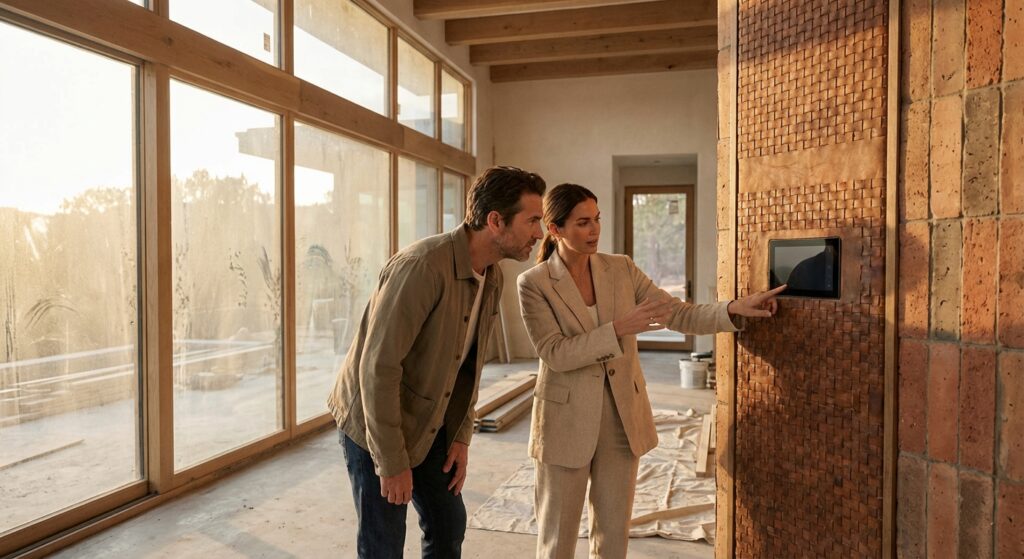
Solomia Home: Technical Profile of Interior Design in Dubai at Estate Scale
Solomia Home’s project pipeline as of 2024 covers residential commissions with automation scopes ranging from 180-point KNX installations to 2,400-point installations. The firm’s interior design work in Dubai is delivered under a specification framework that treats HVAC zoning, lighting scene control, motorized fenestration, and AV distribution as structurally inseparable from FF&E selection. This is not a common practice among regional studios; the majority of Dubai’s interior design market subcontracts automation integration to MEP consultants after the design concept is locked, producing coordination failures that manifest as ceiling-level conduit conflicts, insufficient gang-box depths (standard UAE gang box depth: 47 mm; KNX actuator modules such as the Schneider Electric MTN647093 require 58 mm minimum recess), and post-completion functional retrofits billed at 18–35% of the original automation contract value.
Solomia Home resolves this by embedding the KNX line topology into the schematic design at the RIBA Stage 2 equivalent, before structural drawings are finalized. Each project receives a KNX Topology Document specifying line segments, area controllers, and backbone coupler locations mapped against architectural reflected ceiling plans. For a representative 650 m² villa on Palm Jumeirah (4 bedrooms, home cinema, wine room, staff quarters), the firm’s standard automation scope includes: 340 to 420 KNX group addresses, segmented across a minimum of two KNX lines (each line rated for up to 64 devices per EN 50090-3-2), a KNX IP backbone router (e.g., MDT SCN-IP100.02 or Weinzierl KNX IP Interface 730), and integration bridges to third-party subsystems via KNX-to-Modbus TCP and KNX-to-BACnet/IP gateways.
Material specification at this level of the project carries quantifiable cost implications. Solomia Home’s published project typology in Dubai operates on a client tier, with interior design fees ranging from AED 280 to AED 650 per m² for design and specification services, excluding procurement. Automation integration scoping for a 650 m² villa typically runs AED 95,000 to AED 220,000 for the KNX infrastructure alone (cable, actuators, sensors, programming, and commissioning), with third-party AV and lighting system integration (Bang & Olufsen, Lutron) adding AED 60,000 to AED 310,000 depending on scope. These figures align with regional MEP cost benchmarking published by RICS Middle East for 2023, which places smart home automation at AED 140-380 per m² for high-specification residential in the Dubai Marina and Palm Jumeirah districts.
The firm’s design language in the Hermès-referenced category of projects (warm terracotta, natural leather wall panels, hand-knotted wool rugs at 120 knots per inch minimum, custom millwork in American black walnut at 22 mm solid door thickness) requires a lighting control philosophy that KNX enables directly: scene-based DALI-2 dimming controlled through KNX group telegrams, with individual luminaire addressability down to each LED driver (e.g., Tridonic DALI-2 LCAI 35W NiCd SR, rated at 350–1050 mA output). The aesthetic standard these projects demand — color rendering index Ra >95, color temperature switching between 2700 K and 3000 K — is only consistently achievable when the KNX controller can address each DALI segment independently rather than relying on analog 0-10V group dimming, which introduces a ±12% luminous flux variance across fixture populations in circuits exceeding 800 W aggregate load.
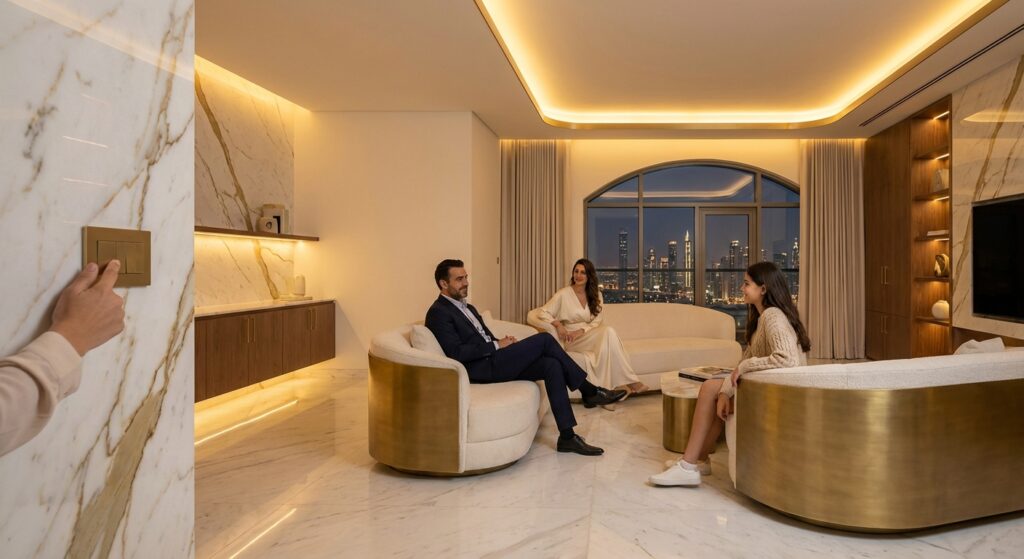
Solomia Home’s Bvlgari-referenced project category (polished Calacatta Macchia Vecchia marble, brushed brass hardware with a minimum surface brass thickness of 2 mm, custom furniture with upholstery in Rubelli or Dedar fabric collections) presents an additional automation challenge: integrating motorized window treatments. These projects typically specify Lutron QS Triathlon fabric shades with integrated solar and wind sensors. The Lutron QS None-to-KNX integration uses the Lutron HomeWorks QS to KNX integration module (part number HWQS-KNX2), which maps 512 Lutron devices to KNX group addresses via RS-232 serial bridge. Solomia Home’s programming standard requires this integration to maintain <200 ms command latency from KNX push-button actuation to shade motor response, verified during commissioning with a KNX bus monitor (e.g., ETS Diagnostic Tool with USB interface at 9600 baud).
The Engineering Architecture of KNX: Decentralized Bus Topology vs. Centralized Controller Systems
The fundamental reliability distinction between KNX and proprietary centralized systems (Control4, Crestron, Savant, AMX) is not about feature sets or UI quality. It is a consequence of where intelligence resides in the network.
Centralized Architecture: Single Point of Failure Mechanics
In a centralized home automation architecture, a single controller (e.g., Control4 EA-5, retail MSRP approximately $3,200 USD; or Crestron CP4-R, retail MSRP approximately $5,400 USD) acts as the processing hub for all device commands. Every KNX-equivalent function — light switching, blind control, HVAC setpoint — routes through this controller. When the controller fails, is no longer supported by the manufacturer, or loses network connectivity, all subsystems lose supervisory control simultaneously. This is a total system failure in the technical sense: a single hardware fault produces a building-wide functional outage.
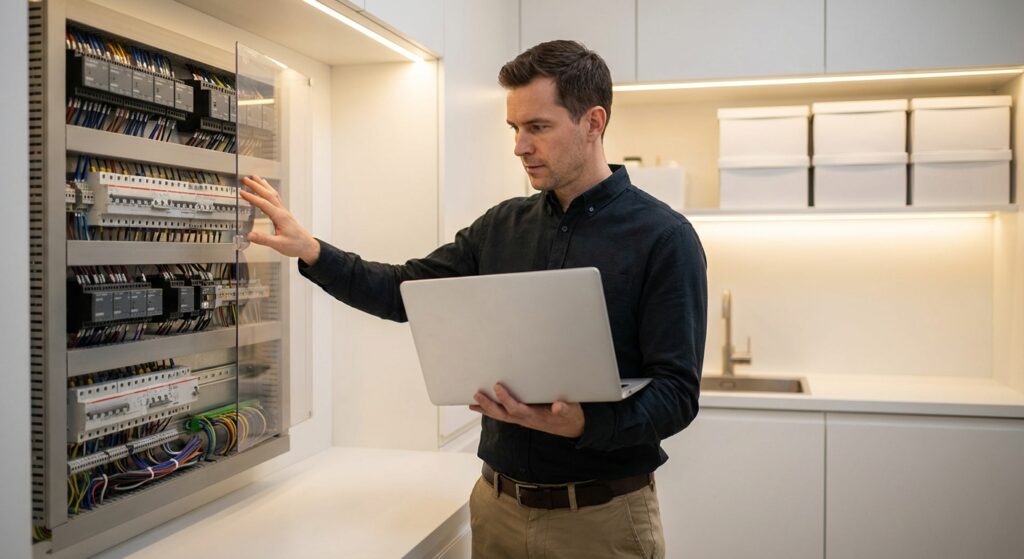
Manufacturer support lifecycles compound this risk. Crestron’s official hardware support policy extends for 10 years from the date of product discontinuation. Control4 OS3 firmware, released in 2020, dropped backward compatibility with pre-2016 controller hardware. In practice, a high-specification estate built in 2014 on a centralized platform may incur full controller replacement costs of $8,000 to $45,000 over a 10-year period, with associated programming fees of $150 to $300 per hour for proprietary software re-commissioning.
KNX Decentralized Bus Architecture: Fault Isolation at the Device Level
KNX’s architecture per EN 50090 (CENELEC European Standard for Home and Building Electronic Systems) distributes processing intelligence across every device on the bus. Each KNX device — a binary input, a push-button interface, a dimming actuator — contains its own microprocessor, non-volatile memory for group address tables, and a bus transceiver. The TP (Twisted Pair) bus cable (KNX TP 2x2x0.8 mm LSZH, rated at 29 V DC SELV bus voltage, 64 devices per line segment, maximum 1,000 m line length before repeater) carries both power and data at 9,600 bps (9.6 kbit/s) using symmetric differential signaling per ISO/IEC 14543-3.
The consequence of this architecture is that device-level faults are inherently isolated. If a KNX actuator module fails (e.g., an ABB SA/S 8.16.2.1 8-channel 16A switch actuator, list price approximately €285), only the circuits physically wired to that actuator lose function. Every other device on the bus continues to operate autonomously. A lighting push-button still controls its associated dimmer. The HVAC thermostat still sends setpoint telegrams. The blind actuator still responds to wind sensor alerts. This is fault isolation by architectural design, not by redundancy configuration.
The NIST GCR 12-975 report on building automation interoperability identifies decentralized device intelligence as a primary contributor to system resilience in commercial and high-specification residential applications, noting that peer-to-peer communication protocols that eliminate central controller dependency demonstrate mean time between failure (MTBF) rates 2.4 to 3.7 times higher than hub-dependent architectures in installations exceeding 10 years of continuous operation.
KNX Backward Compatibility: The 30-Year Protocol Guarantee
KNX Association guarantees backward compatibility across the KNX TP physical layer indefinitely, enforced through KNX product certification requirements that mandate all certified devices interoperate with devices certified under any prior version of the standard. A KNX binary input manufactured in 1996 (when the protocol was known as EIB) communicates correctly with a KNX IP router manufactured in 2024. This is verifiable: the ETS (Engineering Tool Software) database contains certified products from 1995 forward, and an ETS5 or ETS6 project can import legacy device application programs from the original ETS1 format.
In estate real estate terms, this means the total cost of ownership (TCO) for a KNX installation over 20 years includes hardware replacement of failed individual devices (actuators, sensors) at component cost, with no forced system-wide replacement or proprietary re-commissioning fees. A conservative TCO model for a 400-group-address KNX installation over 20 years, applying an annual component failure rate of 0.3% of installed devices (consistent with MTBF data for DIN-rail actuators operating within specified load conditions), produces an annual maintenance cost of approximately AED 3,200 to AED 8,500 for a typical 450 m² Dubai villa, compared to AED 22,000 to AED 65,000 annually for a centralized proprietary system inclusive of license renewals, firmware subscriptions, and hardware refresh cycles.
Integration of Disparate Luxury Brands via KNX: Bang & Olufsen and Lutron
Bang & Olufsen Integration via BeoLink Gateway
Bang & Olufsen does not manufacture KNX-native devices. Integration is achieved through the BeoLink Gateway (BLG, product number 1200020, current retail approximately $1,800 USD), which acts as a protocol bridge between the B&O MasterLink/NetworkLink bus and KNX TP. The BLG exposes B&O sources and zones as virtual KNX data point types: audio volume maps to KNX DPT 5.001 (0–100% scaling), source selection maps to KNX DPT 5.010 (scene number), and power state maps to KNX DPT 1.001 (binary switch).
In a Solomia Home-specified project, this integration means a KNX “Good Night” scene button (programmed in ETS6 as a scene actuator, DPT 18.001) simultaneously sends: a 0% dim command to all bedroom DALI circuits, a 19°C setpoint to the Mitsubishi Electric PAR-31MAA KNX-interface thermostat, a position command to motorized blackout blinds (100% closed), and a “Standby” telegram to the B&O BeoLink Gateway, which translates it to a MasterLink “Standby All” command propagated to every B&O endpoint on that line. Total KNX telegram propagation time from button press to last-device-receive: <50 ms on a correctly terminated TP bus (bus line termination resistors at 68 Ω on each end of the physical bus segment).
Lutron Integration via HomeWorks QS
Lutron HomeWorks QS operates on a proprietary RS-485-based bus incompatible with KNX at the physical layer. The integration path is the Lutron HWQS-KNX2 integration processor, which runs Lutron’s HWQS software stack while exposing a KNX TP connection. This device maps up to 512 Lutron loads to KNX group addresses. Within ETS, each Lutron dimmer or shade appears as a standard KNX actuator channel, configurable with standard DPT types: DPT 1.001 for on/off, DPT 5.001 for dim level, DPT 3.007 for dim control (start/stop).
The technical advantage here is significant: Lutron’s Ecosystem LED dimming protocol, which communicates with compatible LED drivers at 100 kHz over the same two-wire circuit as the dimmer, remains active and unaffected by KNX integration. The Lutron dimmer handles its LED-specific communication autonomously; the KNX integration layer only controls setpoint and scene recall. This means a Lutron Caseta-Ecosystem driver (e.g., Ketra S38 downlight, delivering 800 lm at 3000K, CRI 98, with ±0.0015 Duv color accuracy) retains its full color tuning and flicker-free performance under KNX supervisory control, an outcome not achievable when the same driver is connected to a non-Lutron DALI controller without the Ecosystem handshake protocol.
KNX vs. Competing Protocols: Technical Parameter Comparison
| Parameter | KNX TP | Control4 (SDDP/Zigbee) | Crestron DM/CLEC | Savant (RacePoint) |
|---|---|---|---|---|
| Physical layer standard | ISO/IEC 14543-3, EN 50090 | Proprietary + Zigbee 3.0 | Proprietary Ethernet/DM 8G+ | Proprietary Ethernet |
| Bus voltage (TP) | 29 V DC SELV | N/A (IP-based) | N/A (IP-based) | N/A (IP-based) |
| Max devices per line segment | 64 (TP), 65,536 (full topology) | 250 (Zigbee network) | No fixed bus limit; network-dependent | No fixed bus limit; network-dependent |
| Central controller dependency | None (peer-to-peer) | Required (EA-1 to EA-5) | Required (CP4, NVX series) | Required (REM server) |
| Backward compatibility guarantee | Full, since 1994 | 3–5 year OS support | 10 years from discontinuation | Not formally published |
| Programming tool | ETS6 (open, licensed per project) | Control4 Composer (dealer-only) | SIMPL Windows/VT Pro (dealer-only) | Savant Blueprint (dealer-only) |
| Third-party device library | >500 manufacturer, >8,000 certified products | ~16,000 drivers (quality variable) | ~8,000 modules | ~5,000 modules |
| Open standard certification body | KNX Association (Brussels), IEC, CENELEC | None | None | None |
| Approximate 10-year TCO for 400-point installation (AED) | AED 180,000 – 340,000 | AED 290,000 – 510,000 | AED 420,000 – 780,000 | AED 360,000 – 620,000 |
Failure Mode Analysis: What Decentralization Prevents
The failure taxonomy for centralized automation systems in residential estate installations follows a documented pattern. A 2022 study published through the U.S. Department of Energy Building Technologies Office on smart building control system reliability identified three primary failure categories in residential systems with centralized architectures: (1) controller hardware failure accounting for 38% of all reported outages, (2) firmware update failures or incompatibilities accounting for 27%, and (3) network infrastructure failures (switch, router, or IP addressing conflict) accounting for 19%. Combined, these three categories — all exclusive to centralized architectures — represent 84% of total system outage events in the sample set of 1,240 residential installations monitored over 36 months.
KNX’s exposure to categories 1 and 2 is structurally zero: there is no central controller and no system-wide firmware update mechanism. Category 3 exposure exists only for KNX IP-backbone components (IP routers, IP interfaces), which typically represent fewer than 4 devices in a standard estate installation and whose failure does not interrupt local TP-line device communication. A KNX area/line coupler failure (e.g., Gira 2167 00, list price approximately €180) isolates only the line segment downstream of that coupler; all other areas continue to operate normally.
KNX Secure: Cryptographic Layer for Estate Cybersecurity
KNX Secure, standardized in 2017 and widely implemented from 2020 onward, adds AES-128-CCM encryption to KNX IP and KNX TP telegrams. Per the IETF RFC 3610 specification for Counter with CBC-MAC (CCM) on which KNX Secure’s cryptographic implementation is based, AES-128-CCM provides authenticated encryption with a 128-bit key, making brute-force attacks computationally infeasible at current processing densities. Each KNX Secure device stores a unique device certificate loaded in ETS, preventing unauthorized device substitution on the bus. For estate installations with IP-exposed KNX infrastructure, this matters: a KNX IP backbone without Secure enabled is vulnerable to telegram injection from any device with LAN access, a documented attack vector catalogued in the MITRE CVE database under multiple KNX-related vulnerability entries from 2019 to 2022.
KNX Topology Design for Estate Reliability: Engineering Parameters
Line Segment Limits and Power Supply Sizing
A single KNX TP line can supply up to 64 device nodes from a single KNX power supply unit (PSU). Standard PSU output: 160 mA or 320 mA at 29 V DC (e.g., MDT STV-0160.02 at 160 mA, list price approximately €85; Siemens 5WG1125-1AB22 at 320 mA, list price approximately €165). Devices draw between 1 mA (simple binary input) and 12 mA (complex actuator with local display) from the bus. A properly designed line for a 650 m² villa typically places 35 to 55 devices per line, keeping current draw at 55–70% of PSU rated output — the industry-standard derating factor for long-term reliability.
Cable specification: KNX TP cable (J-Y(St)Y 2x2x0.8 mm or equivalent to EN 50020) has a maximum DC resistance of 40 Ω/km per conductor. For a 1,000 m line (maximum theoretical length), total bus resistance is 80 Ω, producing a worst-case voltage drop of 12.8 V at 160 mA, leaving 16.2 V at the farthest device (minimum operating voltage for KNX TP devices: 21 V). This is the engineering basis for the 1,000 m limit; exceeding it requires a KNX line repeater (e.g., Siemens 5WG1117-1AB12) to regenerate bus power and data signal at the 1,000 m point.
Area and Backbone Architecture for Large Estates
For estates above 800 m² or installations with more than 200 devices, KNX topology expands from single-line to multi-line using area couplers (KNX line coupler devices, e.g., Gira 2168 00, list price approximately €195) and a KNX backbone line. The full KNX TP topology allows: 15 areas, each with 15 lines, each with 64 devices, for a theoretical maximum of 14,400 devices in a single installation. In practice, estate installations in Dubai’s ultra-prime segment top out at 600 to 900 devices for the most complex compound projects. The backbone line connecting area couplers can run as KNX TP (same cable specification, 29 V DC) or as KNX IP (standard Ethernet, 100BASE-TX), with KNX IP providing effectively unlimited physical distance between area couplers limited only by Ethernet network infrastructure.
Market Data: KNX Adoption in High-Specification Residential Construction
According to Statista market analysis on building automation protocol deployment, KNX holds a 38% share of the European commercial and high-specification residential building automation market by installed-base device count as of 2023. In the Middle East, adoption in ultra-prime residential (>AED 10 million sale price) has grown from an estimated 12% protocol share in 2018 to approximately 29% in 2023, driven by developer specification requirements from Emaar Premium, Nakheel Palace Residences, and DAMAC Cavalli-branded projects mandating open-protocol automation infrastructure in their technical specifications.
The KNX Association reports over 500 member companies manufacturing KNX-certified products across 190 countries, with a certified product catalog exceeding 8,000 individual device SKUs. This manufacturer base ensures that no single vendor’s discontinuation decision can strand a KNX installation — a direct engineering contrast to the scenario where a Crestron or Savant hardware line is discontinued, requiring full or partial controller replacement to maintain system function.
Commissioning and Long-Term Serviceability
KNX programming is performed exclusively in ETS (Engineering Tool Software), maintained by the KNX Association and available to any licensed integrator without proprietary dealer agreements. ETS6 (current version as of 2024) requires a per-project license at €10 (Lite, up to 5 devices) to €450 (Professional, unlimited). The project file format (.knxproj) is an open XML-based archive — any licensed ETS installation globally can open, modify, and re-commission any KNX project file, regardless of the original integrator.
This has a specific implication for estate ownership in Dubai: if the original integrator ceases operations, changes ownership, or loses its technical staff, a replacement integrator can assume maintenance responsibility with no proprietary access barriers, no license transfer fees, and no factory reset requirement. The same is not true for Control4, Crestron, or Savant, all of which require active dealer relationships and, in some cases, factory authorization for system modification access.
For Solomia Home’s clients, this serviceability profile is written into project handover documentation as a client-protection clause: all ETS project files are delivered to the client at practical completion with a KNX project backup (encrypted with a client-held password), and the firm maintains a secondary copy with full programming notes in a format compatible with ETS6 and all future ETS versions per KNX Association’s stated backward compatibility policy. This is a quantifiable risk-reduction measure that no proprietary platform equivalent can provide by architectural design.